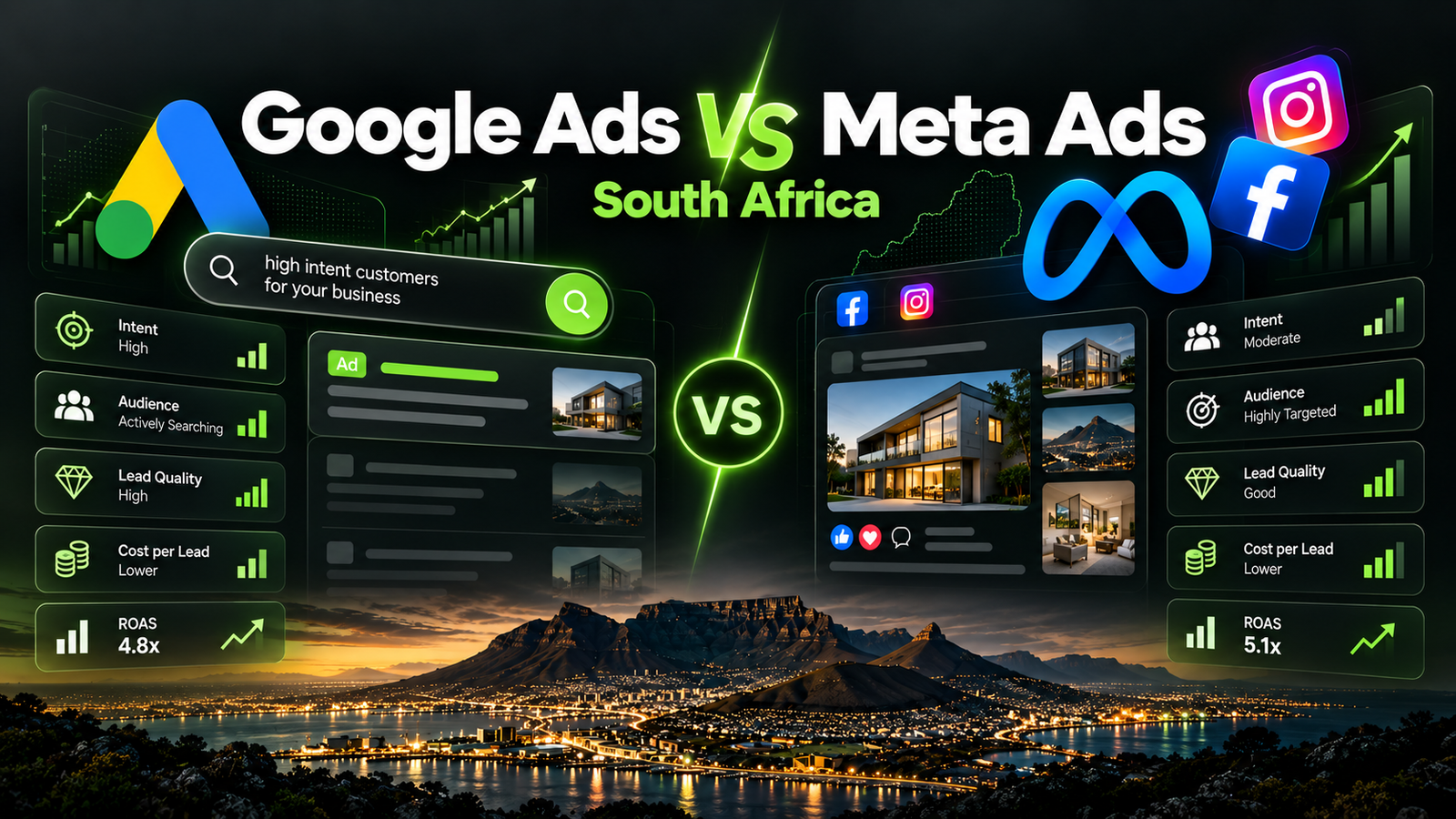
Google Ads and Meta Ads are two of the most important paid media platforms available to South African businesses, but they work in very different ways.
Google Ads is strongest when customers are already searching for a solution. Meta Ads is strongest when a business needs to create demand, build awareness or reach people before they actively search.
The better platform depends on your offer, audience, buying cycle, conversion tracking and commercial goals.
This guide compares Google Ads and Meta Ads across intent, targeting, lead quality, cost, creative, tracking and the situations where each platform is most useful.
Google Ads vs Meta Ads: The Core Difference
The biggest difference is how demand is captured.
Google Ads
Google Search generally reaches people who are already looking for a product, service or solution.
This makes it especially valuable for:
- high-intent enquiries
- local services
- B2B lead generation
- urgent needs
- products with existing search demand
- customers close to a buying decision
Meta Ads
Meta Ads can reach people based on audience signals, interests, behaviours and engagement across Facebook and Instagram.
This makes it useful for:
- creating demand
- introducing new offers
- visual products and services
- remarketing
- broader audience reach
- early-stage consideration
In simple terms:
Google captures demand. Meta can help create it.
Which Platform Has Stronger Customer Intent?
Google Search usually has stronger immediate intent because users are actively searching.
For example, someone searching:
accounting firm near me
or:
industrial solar installer South Africa
is expressing a direct need.
Meta users are usually not searching in the same way. They are browsing Facebook or Instagram and may encounter an offer that is relevant to them.
This means Meta often requires stronger creative and messaging to interrupt attention and generate interest.
Which Platform Offers Better Targeting?
Both platforms offer powerful targeting, but they approach it differently.
Google Ads Targeting
Google can use:
- search keywords
- search intent
- geographic targeting
- audiences
- demographics
- remarketing
- first-party data
Search keywords are particularly valuable because they reveal what a user is actively looking for.
Meta Ads Targeting
Meta can use:
- interests
- behaviours
- demographics
- custom audiences
- website visitors
- customer lists
- lookalike audiences
- engagement audiences
Meta can be strong when the target customer can be defined by characteristics and behaviour rather than a specific search query.
Which Platform Generates Better Leads?
Neither platform automatically generates better leads.
Lead quality depends on:
- the offer
- targeting
- landing-page experience
- creative
- form design
- qualification
- conversion tracking
- sales follow-up
Google Search can often produce stronger immediate intent.
Meta can generate high-quality leads when creative, audience and offer are aligned properly.
A cheaper lead is not always a better lead.
The more useful metric is often whether those leads become qualified opportunities and customers.
Which Platform Is Cheaper?
There is no universal answer.
Google Ads costs depend heavily on:
- keyword competition
- industry
- location
- search demand
- bidding strategy
- quality and relevance
Meta Ads costs depend on:
- audience competition
- creative quality
- campaign objective
- frequency
- placement
- conversion rate
A lower cost per click or cost per lead does not automatically mean better performance.
The real comparison should be based on:
- qualified lead cost
- acquisition cost
- revenue
- profit
- customer value
Which Platform Is Better for B2B?
Google Ads is often a strong fit for B2B when customers actively search for the service.
Examples include:
- software solutions
- consulting
- professional services
- industrial services
- specialist suppliers
Meta can still be valuable for B2B when used for:
- awareness
- remarketing
- educational content
- thought leadership
- lead generation
- account-based audience strategies
For many B2B businesses, Google captures active demand while Meta supports awareness and nurture.
Which Platform Is Better for E-commerce?
Both can be useful.
Google Ads can capture product searches and shopping intent.
Meta Ads can generate demand through strong visual creative, product discovery and remarketing.
E-commerce businesses often benefit from using both platforms across different stages of the buying journey.
Creative Requirements: Google vs Meta
Google Ads
Search advertising relies heavily on:
- keyword relevance
- headlines
- descriptions
- offers
- landing-page relevance
The user already has intent, so the ad needs to show why your offer is relevant.
Meta Ads
Meta is much more creative-dependent.
Strong Meta creative often includes:
- short-form video
- product demonstrations
- testimonials
- problem-solution messaging
- strong visual hooks
- clear offers
- educational content
Weak creative can limit Meta Ads performance even when targeting is strong.
Conversion Tracking Matters on Both Platforms
Accurate tracking is essential for both Google Ads and Meta Ads.
Useful conversions can include:
- form submissions
- calls
- purchases
- booked consultations
- qualified leads
- revenue
- CRM outcomes
Without reliable conversion tracking, both platforms can optimise toward signals that look good inside the advertising account but do not produce commercial value.
Google Ads vs Meta Ads for Remarketing
Both platforms can be effective for remarketing.
Google can reconnect with previous visitors through Display, YouTube and other campaign types.
Meta can reconnect with:
- website visitors
- video viewers
- social engagers
- previous leads
- customer lists
Remarketing can be especially useful when customers need multiple interactions before converting.
When Should You Use Google Ads?
Google Ads may be the stronger starting point when:
- customers actively search for your service
- search intent is high
- there is established market demand
- the buying decision is urgent
- lead quality matters more than broad reach
- you need to capture demand quickly
You can read our full guide to Google Ads in South Africa.
When Should You Use Meta Ads?
Meta Ads may be the stronger starting point when:
- customers are not actively searching yet
- visual creative is important
- the offer needs awareness
- you have a broad addressable audience
- remarketing matters
- you want to generate demand before search begins
You can read our full guide to Meta Ads in South Africa.
Should You Use Google Ads and Meta Ads Together?
For many businesses, the strongest strategy is not choosing one platform permanently.
The platforms can support different stages of the customer journey.
A combined approach may look like:
- Meta creates awareness
- Meta introduces the offer
- Google captures active search demand
- Meta remarketing reconnects with previous visitors
- Google remarketing supports additional touchpoints
- analytics connects both channels to leads and revenue
This creates a more complete acquisition system than treating each advertising platform in isolation.
How Should You Decide Where to Spend More?
Budget allocation should follow commercial evidence.
Review:
- qualified lead volume
- cost per qualified lead
- acquisition cost
- conversion rate
- sales velocity
- revenue
- ROAS
- customer lifetime value
Avoid allocating budget based only on impressions, clicks or platform-reported lead volume.
The platform generating the strongest business outcomes should earn more investment.
When Should You Work With a Performance Marketing Agency?
Professional support can be useful when:
- you are running both Google and Meta campaigns
- tracking is inconsistent
- lead quality differs significantly between platforms
- budget allocation is unclear
- campaign spend is increasing
- landing-page performance is weak
- platform results are disconnected from CRM or sales data
Dynamic Clicks provides performance marketing services across Google Ads, Meta Ads, paid media, conversion tracking and measurement.
Frequently Asked Questions
Is Google Ads better than Facebook Ads?
Not universally.
Google Ads is often stronger for capturing active search demand, while Facebook Ads can be effective for creating demand, visual storytelling and remarketing.
The better platform depends on the business and customer journey.
Which platform produces cheaper leads?
Either platform can produce cheaper leads depending on the industry, audience, offer and campaign setup.
Lead quality should be considered alongside cost.
Should a small business use Google Ads or Meta Ads first?
A small business with strong search demand may benefit from starting with Google Ads.
A business that relies on visual discovery or needs to create demand may benefit from Meta Ads.
The decision should be based on customer behaviour rather than platform popularity.
Can Google Ads and Meta Ads track the same customer?
Both platforms may attribute conversions to their own campaigns, which can create overlapping attribution.
Analytics and CRM data can help businesses evaluate the wider customer journey more accurately.
How much should I spend on each platform?
There is no fixed percentage that works for every business.
Budget should be allocated according to demand, campaign performance, lead quality, acquisition cost and revenue contribution.
Build the Right Paid Media Mix
Google Ads and Meta Ads do not need to compete for the same role.
Google can capture people who are already searching, while Meta can create awareness and influence customers earlier in the journey.
The strongest strategy is usually the one that connects both platforms to accurate measurement and real commercial outcomes.
Explore our performance marketing services or contact Dynamic Clicks to discuss the right paid media mix for your business.