
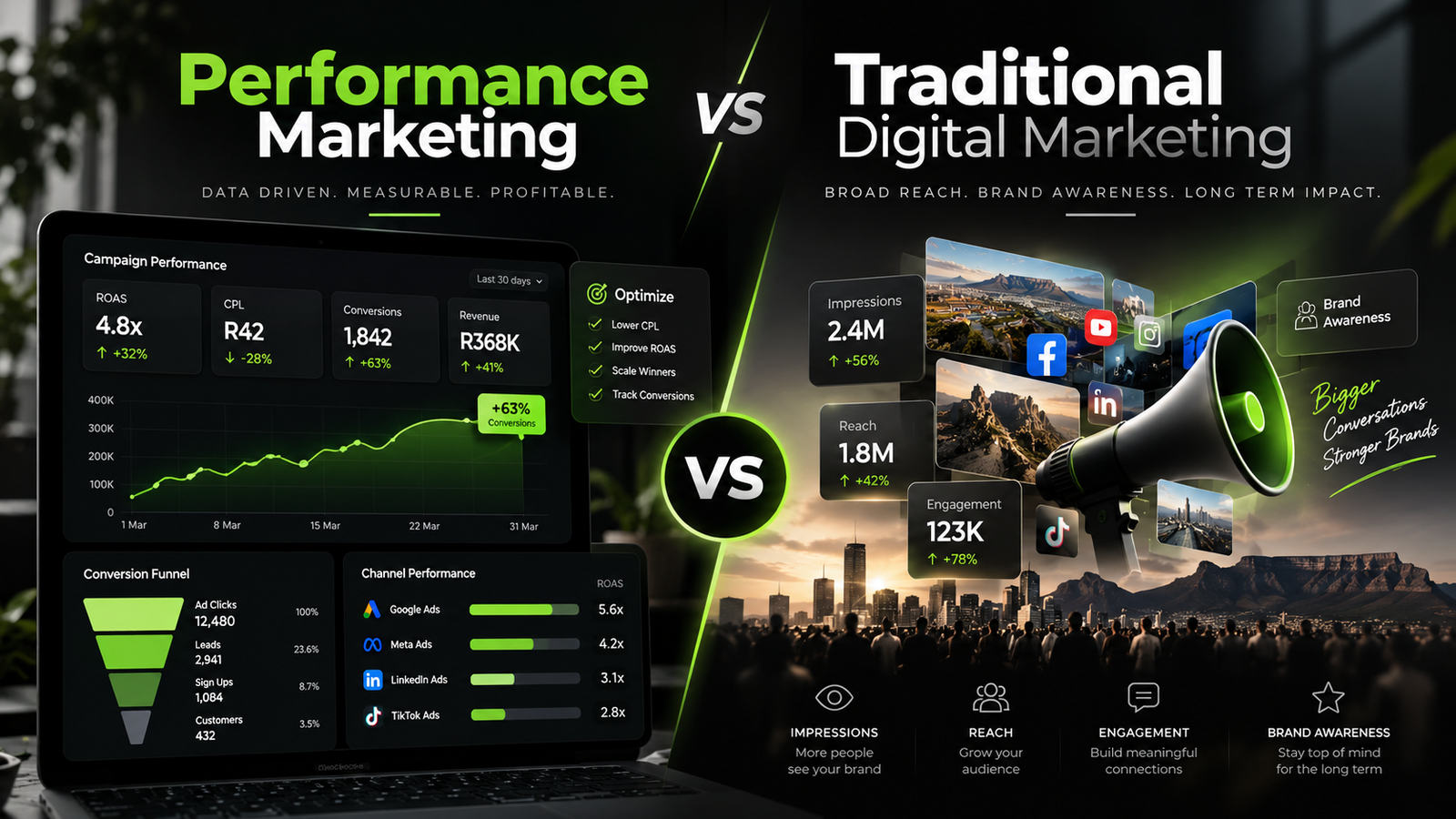
Performance marketing and traditional digital marketing are often grouped together, but they are not the same.
Both can use digital channels, paid media and online content. The difference is mainly in how campaigns are planned, measured and optimised.
Performance marketing is built around measurable actions and commercial outcomes.
Traditional digital marketing may focus more broadly on reach, awareness, visibility and engagement.
For South African businesses, understanding the difference helps clarify where each approach fits and how marketing budgets should be evaluated.
What Is Performance Marketing?
Performance marketing is a results-focused approach to digital marketing.
Campaigns are usually measured against outcomes such as:
- leads
- sales
- revenue
- cost per acquisition
- return on ad spend
- qualified opportunities
- customer value
The goal is to connect media activity as closely as possible to measurable business results.
This often involves:
- conversion tracking
- analytics
- CRM data
- attribution
- campaign optimisation
- lead quality measurement
- revenue reporting
What Is Traditional Digital Marketing?
Traditional digital marketing is a broader category.
It can include activities such as:
- display advertising
- social media marketing
- email marketing
- content marketing
- online brand campaigns
- video advertising
- website promotion
These activities may still be measurable, but the primary objective is not always direct conversion or revenue.
Some campaigns may be designed mainly to improve awareness, reach or brand recognition.
The Main Difference
The biggest difference is the level of accountability to measurable outcomes.
Performance marketing asks:
What business result did this activity generate?
Traditional digital marketing may ask:
How many people saw, clicked or engaged with this activity?
Both questions can be useful.
The important distinction is whether marketing performance is being tied directly to commercial outcomes.
Performance Marketing Focuses on Measurable Actions
Performance marketing usually prioritises actions that can be tracked.
These may include:
- form submissions
- phone calls
- purchases
- bookings
- account registrations
- qualified leads
- sales opportunities
- revenue
This makes it easier to compare campaign efficiency over time.
Traditional Digital Marketing Often Includes Upper-Funnel Goals
Traditional digital marketing can place greater emphasis on:
- impressions
- reach
- awareness
- engagement
- video views
- website traffic
These metrics can still provide value.
However, they do not automatically show whether marketing is contributing to revenue.
Measurement Is a Major Difference
Performance marketing depends heavily on accurate measurement.
Without reliable tracking, it becomes difficult to know which campaigns are driving meaningful results.
A strong measurement system may include:
- Google Analytics
- advertising platform tracking
- CRM integration
- offline conversion tracking
- call tracking
- ecommerce revenue data
- attribution reporting
Traditional digital marketing may rely more heavily on platform-reported engagement metrics.
Optimisation Happens Differently
Performance marketing campaigns are usually adjusted based on measurable results.
Budget can move toward:
- better-performing campaigns
- higher-quality audiences
- stronger keywords
- better creatives
- more profitable products
- higher-converting landing pages
Campaigns that underperform can be reduced or changed.
This creates a continuous optimisation process.
Performance Marketing Uses Feedback Loops
One of the strongest advantages of performance marketing is the feedback loop.
Campaign data generates results.
Those results inform optimisation.
Optimisation improves targeting, bidding, creative and budget allocation.
The process then repeats.
This means campaigns can become more efficient as more reliable data becomes available.
Cost Efficiency
Performance marketing often gives businesses clearer visibility into cost efficiency.
Common metrics include:
- cost per click
- cost per lead
- cost per qualified lead
- cost per acquisition
- return on ad spend
- customer acquisition cost
These metrics help marketers understand how efficiently budget is being used.
Read our guide on how to reduce cost per lead in paid media for a more detailed look at acquisition efficiency.
Lead Quality Matters
A campaign can generate many leads and still perform poorly.
Performance marketing should consider what happens after the lead is generated.
Important downstream metrics include:
- qualified lead rate
- sales conversion rate
- time to sale
- average deal value
- customer lifetime value
This is why lead quality should be measured alongside CPL.
ROAS Is a Core Performance Metric
Return on ad spend is commonly used to evaluate paid media efficiency.
ROAS can help businesses compare campaign performance, but it should not be viewed in isolation.
Profit, acquisition cost and customer value also matter.
Read our guide to ROAS in South Africa.
Google Ads and Performance Marketing
Google Ads is commonly used in performance marketing because search campaigns can capture existing demand.
Users may already be searching for:
- a service
- a product
- a provider
- a solution
This makes search intent highly measurable.
Read our guide to Google Ads in South Africa.
Meta Ads and Performance Marketing
Meta Ads is also widely used in performance marketing.
It can be effective for:
- generating demand
- remarketing
- lead generation
- ecommerce
- audience testing
- creative testing
The platform can be highly measurable when conversion tracking and CRM feedback are configured properly.
Read our guide to Meta Ads in South Africa.
Performance Marketing vs Brand Marketing
Performance marketing is not the same as brand marketing.
Brand marketing focuses more on:
- awareness
- perception
- trust
- market presence
- long-term preference
Performance marketing focuses more on:
- conversion
- revenue
- acquisition
- measurable efficiency
The two can support each other.
Strong brands often improve performance campaigns because customers are more likely to recognise and trust the advertiser.
Performance Marketing vs Traditional Digital Marketing: Key Differences
Objective
Performance marketing: measurable business outcomes.
Traditional digital marketing: broader visibility, engagement and communication goals.
Measurement
Performance marketing: conversion, revenue and acquisition metrics.
Traditional digital marketing: often includes reach, impressions and engagement.
Optimisation
Performance marketing: continuous adjustment based on results.
Traditional digital marketing: may use broader campaign planning and periodic optimisation.
Accountability
Performance marketing: spend is closely tied to measurable outcomes.
Traditional digital marketing: value may also include brand and awareness effects that are harder to attribute directly.
Does Performance Marketing Replace Traditional Digital Marketing?
No.
Performance marketing does not make awareness, brand building or upper-funnel activity unnecessary.
Businesses still need:
- visibility
- credibility
- trust
- content
- market presence
The strongest approach often combines brand-building activity with measurable performance systems.
When Performance Marketing Works Best
Performance marketing is especially useful when:
- conversions can be tracked
- lead or sales value is known
- sufficient data is available
- campaigns can be tested
- budgets can be reallocated
- customer journeys can be measured
It is particularly effective for businesses that want clearer accountability from paid media.
When Traditional Digital Marketing Still Matters
Traditional digital marketing remains useful when:
- building a new brand
- entering a new market
- launching a new product
- increasing awareness
- educating customers
- developing long-term demand
These goals may not produce immediate measurable revenue, but they can support future performance.
Use Both Approaches Strategically
The choice does not always need to be performance marketing or traditional digital marketing.
Businesses can use both.
For example:
- awareness campaigns create demand
- content builds trust
- Google Ads captures intent
- Meta Ads creates and retargets demand
- landing pages convert traffic
- analytics measures outcomes
- CRM data feeds performance back into campaigns
This creates a more complete marketing system.
Which Approach Should South African Businesses Use?
The right approach depends on:
- business model
- sales cycle
- customer journey
- budget
- tracking maturity
- growth objectives
- brand awareness
- existing demand
Businesses with strong measurement systems can usually gain more value from performance marketing because they can optimise against real results.
Businesses with low awareness may still need upper-funnel activity to create future demand.
When Should You Work With a Performance Marketing Agency?
Professional support may be useful when:
- ad spend is increasing
- CPL is rising
- lead quality is inconsistent
- revenue attribution is unclear
- tracking is incomplete
- campaigns are not connected to CRM data
- marketing teams struggle to identify what is actually driving growth
Dynamic Clicks provides performance marketing services focused on paid media, conversion tracking, analytics and commercial outcomes.
Frequently Asked Questions
What is performance marketing?
Performance marketing is a results-focused approach where campaigns are measured against actions such as leads, sales, revenue or customer acquisition.
Is performance marketing the same as digital marketing?
No.
Performance marketing is a subset of digital marketing that places stronger emphasis on measurable outcomes and optimisation.
Is social media marketing performance marketing?
It can be.
Social media campaigns become performance marketing when they are measured and optimised against outcomes such as leads, sales or revenue.
Is SEO performance marketing?
SEO is generally considered a broader digital marketing discipline, although it can still be measured against leads, conversions and revenue.
Is performance marketing only paid advertising?
No.
Paid media is a major part of performance marketing, but performance systems can also include landing pages, tracking, analytics, CRM integration and conversion optimisation.
Build Marketing Around Measurable Outcomes
Performance marketing gives businesses a clearer way to connect marketing activity with leads, sales and revenue.
Traditional digital marketing still plays an important role in building awareness, trust and demand.
The strongest marketing systems combine both where appropriate, while ensuring that commercial outcomes remain measurable.
Explore our performance marketing services or contact Dynamic Clicks to discuss measurable digital growth.